
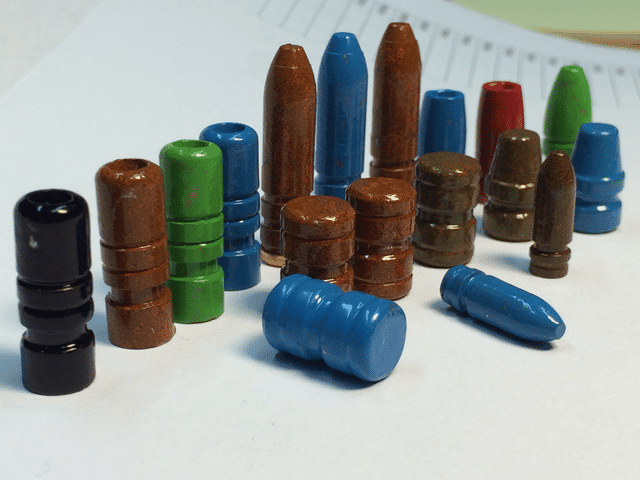
The simplest way to powder coat cast pistol and rifle bullets: shake them with powder in a plastic container, then bake. Step-by-step guide by Gregor Hodnik (Gamsek).
This is the method I use to powder coat (PC) my cast bullets, because it worked so well from the very first try. It can also be called ASBBDT, “dry tumbling with AirSoft BBs as tumbling media”. After getting good results with DT, I never looked back at a spray gun (ESPC, electrostatic powder coating). ESPC can give the smoothest finish, but it needs more setup and cleanup, and some powder is lost. Other methods (piglet method, Hi-Tek with acetone, DT variants that bake in a pile and drop into water) are not covered here.
At a glance
- Container: plastic with a snap-on lid and a triangle with #5 on the bottom.
- Batch: 30–100 bullets, 1 teaspoon of powder for the first load, ½ teaspoon after that.
- Coat: swirl 30 seconds, shake up and down 30 seconds.
- Bake: convection oven at 400F / 200C for 20 minutes (15 if preheated).
What you need
- Powders. Start with powders already proven for DT. Then there’s no preheating, vibratory tumbler or acetone washing: just 60 seconds of shaking and swirling, and no second coat if you follow the instructions.
- Plastic container #5 with a snap-on lid (like cool whip containers). The #5 plastic is very important for the static charge, and a round shape makes swirling easier.
- Convection oven with a fan, for even heat and an almost sprayed look.
- Airsoft BBs (optional, but recommended).
- Blue nitrile gloves. Other gloves remove powder wherever they touch.
- Long needle-nose pliers or tweezers (or long medical forceps). Gregor uses tweezers with bent tips.


Which powder?
I took the easy way and learned from other casters’ tests instead of experimenting with random local powders. On the Cast Boolits forum (castboolits.gunloads.com), member Smoke4320 tested powders from big companies and made a list of powders that work with DT. He is now a vendor sponsor in the USA. Even from Europe (postage, customs) I ordered his powders twice and never regretted it: after 3 years I still use powders from the first shipment. I’d recommend anyone in the USA to start with his “DT tested” powders.
Orders: 704-624-4115, smoke@paintballkingdom.com, or the forum thread.
Why use Airsoft BBs?
Smoke’s powders work without them (depending on the colour), but I almost always use BBs. They cushion my relatively soft lead bullets, improve the static charge and remove excess powder, which gives a perfect coating. Black BBs work best; my yellow and orange work well too. Very smooth white BBs were useless.
Know your oven
Make sure you know the real temperature your oven bakes at (mine was off, as expected). If you can’t measure it, bake a few small batches of 10 bullets until you find the setting that gives a nice, even flow. Too cool and you get clumps, too hot and you melt lead.

Step by step
- Cover the bottom of the #5 container with 2–3 layers of Airsoft BBs (about ½” deep).
- Add 30–100 bullets: about 100 small ones like .223, or only about 30 large ones like 45 ACP 230 gr.
- Add 1 teaspoon of powder for the first load with new BBs and container, ½ teaspoon for later batches. Less is better: you can always add more.
- Close the lid, swirl like crazy for 30 seconds, then shake hard up and down for another 30 seconds. Always finish with shaking. With some powders or high humidity, shake up to 2 minutes.
- Check the coverage. If there’s no powder left at the bottom and coverage isn’t good enough, add a bit more and repeat.


- Pick the bullets up one at a time with tweezers or a nitrile glove, tapping off excess powder into the container (or just blow it off). Dip the tweezer tips or glove fingertips into powder first, so they don’t leave marks. A strainer works too.
- Place the bullets on a tray lined with non-stick foil or parchment paper (it lasts many cycles). Silicone baking mats also work.
- Bake at 400F / 200C for 20 minutes (15 minutes in a preheated oven).
- Take them out and let them cool, or quench them in water.


Water quenching: if you quench bullets straight from the mould, baking the powder coat cancels that first quench, so quench them again after they come out of the oven.


Why powder coat?
- Replaces lube: less mess, not sticky, clean seating dies.
- Often faster and cheaper than Alox or a lubrisizer: push-through sizers are enough.
- Doesn’t dry, melt or crack in long-term storage.
- Less or no smoke, easier cleaning, no lead exposure when handling.
- Lower friction, longer barrel life, lower temperature.
- Colour coding for different loads with the same bullet.
- Usually works in bullet feeders for progressive presses.
- Adds 0.002″–0.003″ to the diameter if you need it, and lets you use soft alloy.
- Works in suppressors and won’t clog compensators or ports.
- Hate colours? Use clear PC for the traditional look.
Tips and troubleshooting
Fit is king
PC isn’t the answer to every problem (leading, tumbling). You still need to fit your cast bullet to your bore. Above all, don’t use undersized bullets.
Size before or after coating?
It depends on the diameter you need. Sometimes I size, attach the gas check and then coat; with tight gas checks I seat them first, then coat (and size again if needed). For 9mm, .38/.357 and .44 I often coat first and then size. A push-through die should never scratch your bullets: if it does, polish it.
The hammer / vice test
Pound a freshly coated bullet with a hammer and squeeze another in a vice. No flaking or peeling? Congratulations, your coating passed.


Still lead in the barrel?
- How much did you flare the case mouth? It may shave coating off while seating. Load a dummy round, pull it apart and check.
- Measure that pulled bullet, especially in 9mm with its tapered case: the case can swage down the bullet base.
- Use slightly oversize bullets. PC replaces lube and helps a lot, but it isn’t magic.
Humidity is your enemy
Low humidity helps the static charge. In a hot, humid, rainy summer, powders that worked well in dry winter suddenly gave poor coverage. What helped:
- Coating indoors (in my case the basement).
- Preheating the bullets.
- Leaving the container, bullets and powder in an air-conditioned room for 2 hours or more.
- Powder kept in a sealed container still worked like new after 3 years.
MP moulds for powder coating
MP Molds makes plenty of NLG (No Lube Groove) moulds for alternative coatings, but remember: you can powder coat any cast bullet, lube groove or not.
There are also moulds sized specifically for powder coating. A good example is Miha’s 357-135 FP Solid 8 cavity aluminium mould, an NLG PC variant of his famous 359-125 HP. It casts .357″, which comes out at about .3585″ with powder coat, so little or no sizing is needed. I size it to .3575″ and it works great in many 9mm pistols and even .38/.357 revolvers.


Further reading
Some of the best “how to” articles on powder coating come from well-respected author, shooter, hunter and fellow caster Jeff “Tank” Hoover, one of the first to write about its advantages:
- Tank’s Powder Coated Cast Bullet Clinic (American Handgunner)
- Powder Coated Bullets (American Handgunner)
Written by Gregor Hodnik (Gamsek)
 English
 German
 French
 Spanish
 Swedish
 Czech
 Polish
 Italian